Announcement: 8th Munich Peace Meeting
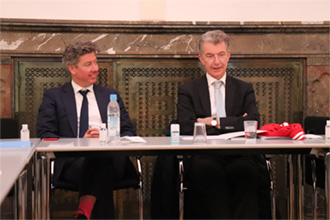
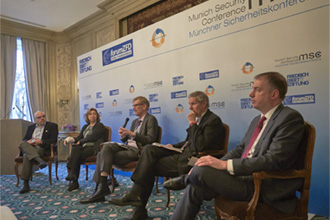
At the suggestion and based on the concept of the project group “Changing the Munich Security Conference” (registered association), this non-public expert dialogue takes place annually with the participation of the Munich Security Conference (MSC) team. This year it will be held on October 21 (preliminary meeting on October 7).
Since 2019, this forum has provided a platform on which peace research, peacebuilding practice, and the peace movement can network with the MSC team, generating concrete input for the upcoming MSC in February of the following year. In connection with the paradigm of peace logic and based on the successful peace practice of the invited participants, we set topics and recommend guests/experts and formats for the MSC.
The objective for this year is formulated as follows: “Balancing the MSC: strengthening international diplomacy by anchoring it in the paradigm of comprehensive human security instead of excessive militarism.”
We have set ourselves the following guiding question: What needs to be addressed at the MSC, with whom, in what format, and with what substantive orientation, if it is to further develop as a platform for “comprehensive human security” (comprehensive human security)?
50 experts from 25 countries will deliberate in four independent focus groups:
- New world order: “Multilateralism in a new world order.” In view of shifting international alliances, the group will examine how insights from emerging and middle powers can shape definitions of security, with a focus on the influence of civil society in these countries on defining and shaping this human security.
- Nonviolence/Cultural resources: “The impulses and impacts of nonviolence and peace actions on human security.” How can insights from nonviolent collective action, as well as from traditional, religious, and spiritual leadership, be incorporated into international peace and security diplomacy?
- Women: “Women in leadership positions in the field of peace and security.” How can women’s voices be strengthened in the discourse on peace and security and be better heard? What would security and peace processes look like if no men were at the table?
- Next Gen: “The next generation for peace and security.” How can young people be empowered as agents of change for peace and security? How can the involvement of the next generation in international peace and security diplomacy be designed and ensured?
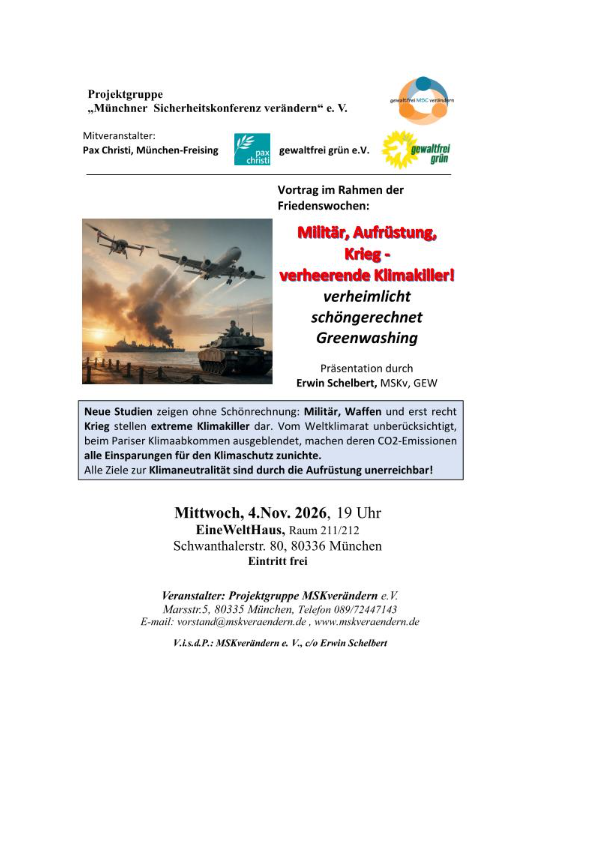
Announcement: Lecture as part of the Munich Peace Weeks
Where: EineWeltHaus, Room 211/212
When: Wednesday, November 4, 2026, 7:00 PM
Who: Erwin Schelbert, Project Group “Münchner Sicherheitskonferenz verändern” e.V.
Topic: Military, Rearmament, War – devastating climate killers!
Concealed – sugar-coated – greenwashing.
New studies show without sugar-coating: military, weapons, and especially war, represent extreme climate killers. Unconsidered by the IPCC and ignored in the Paris Climate Agreement, their CO2 emissions nullify all savings for climate protection.
All goals for climate neutrality are unattainable due to rearmament!
We look forward to your participation and an interesting discussion after the presentation.
Admission is free.
You can find the flyer for the event here
Thought Memo No. 48 – Peace or War? Human Ethics for Artificial Intelligence
Ladies and Gentlemen, dear friends of peace,
At the world-renowned Hannover Messe, German defense companies exhibited innovative production technologies “to support the security and defense industry.” Peace activists, scientists, and religious representatives have been warning for years about the danger of war posed by new automated weapon systems and Artificial Intelligence (AI). Instead of arms shows, we need a social dialogue that places AI within the framework of human ethics.
AI is in the process of changing the world: science, economy, geopolitics. The topic also plays a role at the Munich Security Conference (MSC), but with a one-sided focus on military and criminal use. The side event “From Cyberwar to Cyberpeace” proposed by MSKverändern, which addressed the ethical dimensions and peace-promoting potential of AI, was unfortunately not taken up by the conference management.
While AI is analyzed in the context of warfare and the digital competition between great powers, a link to insights from peace ethics, philosophy, and theology has been missing so far. There is also a lack of consideration for perspectives from the Global South. When one considers the global destructive potential of AI and its military and criminal use, this deficit is not just a blind spot, but a veritable security risk.
An intensive dialogue on ethical questions regarding AI would be important—between North, South, East, and West, and between politics, technology, ethics, and religious communities. In this regard, I was impressed by the Vatican’s sober and well-founded analysis: the role of human decisions in AI-supported warfare and the enormous AI resource consumption of energy and water are presented and weighed here (Antiqua et Nova, January 2025).
Experts compare the historical-transformative significance of AI to the invention of the atomic bomb. I call for spending not only vast sums on the military use of AI, but also investing in the peace-building potential of AI, e.g., in education, medicine, ecology, and development cooperation. For AI, too, the following must apply: less readiness for war, more capacity for peace!
And what are your thoughts on “Alexa, ChatGPT and Co.” at the MSC?
Sincerely,
Dr. Peter Bender
Peter Bender is a political scientist and theologian and a member of the board of Religions for Peace
Germany e.V. He regularly participates in the dialogue between MSKverändern and the
Munich Security Conference.