Press release MSKv and rethinking security for MSC 2025

Press release MSKv and rethinking security for MSC 2025 Read More »
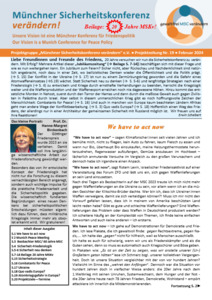
The new edition of our project newspaper is now available for you. This issue again contains many interesting and up-to-date articles. Here is a little preview:
“Dear friends of peace, in a time of right-wing nationalism and extreme armament, in order to be as fit for war as possible, the International Munich Peace Conference is once again drawing attention to the foundations of peace. Our Munich Peace Meeting has also made proposals on this topic (→P.3) and all articles in this project newspaper deal with the central question of peace in the currently prevailing politics, which are determined by the logic of war. Are voices like those of Richard D. Precht and Heribert Prantl still being heard (→P.1)? The fact that medium-range missiles are being stationed in Germany again does not even lead to any significant protests, and the repeatedly invoked raison d’état towards Israel is not questioned despite violations of international law and war crimes (→P.5). This makes it all the more important to support the goals of the ‘Rethinking Security’ campaign – also at the MSC (→P.10) – (→P.6). After all, the MSC itself has already recognized that the West’s double standards call its credibility into question, but unfortunately they continue to be applied (→P.9). Interviews with the CEO of the MSC, Benedikt Franke, reveal that the transatlantic orientation towards the USA under Trump will hardly lead to a European peace architecture (→P.11). Unfortunately, no sustainable contribution can be expected from the parties (election programs) either. This makes our commitment to peace all the more important!”
Don’t miss out on this issue!
Click here to go directly to the project newspaper: 
If you prefer the English version: 
We look forward to receiving your feedback on the content.
02/07/2025: Project Newspaper No. 20 on the MSC 2025 Read More »
Dear friends of peace,
the Munich Security Conference (MSC) publishes well-founded publications to present the military-based foreign and security policy of the NATO states. Conference Director Christoph Heusgen pointed out to us in our last conversation the recent publication “Standard Deviation,” which deals with double standards and double morals of the “West.” And that in an astonishingly critical way for the MSC, even if the violations of the values of the UN Charter are not named with sufficient specificity.
The publication “But NATO – 10 popular myths about Putin’s war against Ukraine” is quite different, both in terms of presentation and content. It is probably intended to be a kind of polemic against the myths and conspiracy theories of extremists and populists, who bring these up in “the emotionally charged discussions.” According to the authors, politics and the public are “not yet practiced in dealing with war,” hence the “Zeitenwende on tour” campaign, for whose accompaniment this publication was written.
To ensure that this practice in dealing with war is as effective as possible, the publication uses a clear black-and-white representation: Each of the 10 myth claims is dualistically opposed to what is correct. One and a half pages of clarification with assertions and also emotional statements are sufficient for this, all with little and questionable reference to sources (e.g. newspaper articles). It seems that it is that simple!
The fact that a war always has extremely complex backgrounds, a conflict genesis that is often not even historically worked through, and that a schematic friend-enemy scheme is unsuitable without considering multi-layered influencing factors and different actors, seems actually trivial. Especially in a conflict that is related to the constellation of nuclear world powers. The meanwhile dominant “Zeitenwende narrative,” constantly repeated by Western politics and the media, therefore by no means represents the irrefutable truth and can equally be regarded as a myth.
At the MSC, an in-depth discussion of these connections, fact-based and with rational argumentation and with the inclusion of different points of view, would have to be conducted in order to counter the myths of any provenance.
What do you think? Do you think such a discussion makes sense? We look forward to hearing your opinion!
With peaceful greetings
Erwin Schelbert
Dear friends of peace,
At our first meeting with MSC Director Ambassador Christoph Heusgen in March 2022, it became clear that he – especially as a former representative of Germany on the UN Security Council – is greatly concerned with the norms of international law and a value-oriented international policy.
Richard David Precht addresses the question of how a value-led foreign policy can be effective in his current book “Century of Tolerance.” He joins the appeals of scientists that preventing climate catastrophe must become the main topic of politics so that people can still lead a life worth living on Earth in the 22nd century. This requires a joint effort by humanity, which is existentially necessary. We can no longer afford another century of escalation, armaments, and world wars! It would be the end of human life.
Precht questions the claims of a “systemic rivalry” between the West and China and the “struggle of democracies against autocracies.” He points out how easily we fall into friend-enemy thinking – us, the good guys, against the evil others – and how selectively we evaluate autocratic regimes, depending on whether they cooperate with us, the West. And Precht emphasizes how little the preaching of “Western values” can convince, especially in the Global South, when this West itself has so often not adhered to these norms – and does not adhere to them! All too often, the West pretends to have values where it is really about its own interests. Instead, a look at the common value foundation of cultures – e.g. “Global Ethos” according to Hans Küng – and global cooperation on an equal footing would be necessary.
I believe that with his theses – only touched upon here – Precht could make an important contribution on the stage of the MSC next February. I would like to inform Mr. Heusgen of this during our online meeting next week.
What do you think of this proposal?
Sincerely,
Thomas Mohr
Chairman Project Group “Changing the Munich Security Conference” e.V.
Chairman gewaltfrei grün e.V.
Dear friends of peace,
“World Without a Compass” is the title of the new Peace Report (FGA) by the four leading peace research institutes. That, at least, appears to be a very accurate analysis.
It is certainly correct and important to note that the year 2023 recorded a sad record in wars and conflicts, an insane peak of 2.4 trillion dollars in worldwide armaments spending, and was also the climatologically hottest year to date.
Not enough: On Europe’s doorstep, two senseless, murderous wars are raging in Ukraine and Gaza, in which we are also involved.
In this situation, shouldn’t peace research provide a clear impetus for an end to violence, an indispensable, clear guide to peace that requires a radical departure from the previous logic of war? Because violence, hatred, and rearmament only ever provoke a spiral of new violence?
Instead, the report’s recommendations state: “To enable negotiations in the war in Ukraine, military support for Ukraine must be sustainably guaranteed and increased.” And since the USA is expected to reduce its support, the demand is: “Europe must compensate for this decline, and that also means it must rapidly increase its armaments capacities.”
This reflects the same military security thinking that has been proclaimed for years at the Munich Security Conference (MSC) by the leading representatives of highly armed states. Its head, Christoph Heusgen, sets the tone: “We must return to a certain logic, as we had in the Cold War,” and he believes he must urge Western states to “expand their military support for Ukraine,” stating that the West must “go all out” with its military aid.
This fits into the general political and societal war hysteria of a so-called “Zeitenwende” (turning point). Sociologist Andreas Reckwitz sees in this an “increasing friend-foe thinking,” “everywhere there is a new culture of mercilessness.”
Should we still uphold our earlier demand to prominently discuss the FGA’s recommendations at the MSC? Or is it precisely now that we should?
What do you think about this? We look forward to hearing your views!
With peaceful regards
Erwin Schelbert
Founding Member of MSKverändern e.V.
Study Group for Peace Research
July 8, 2024: Newsletter No. 43 – The Peace Report 2024 – Serving the Logic of War? Read More »
Dear peace activists,
“A highly armed army, ever more isolation and surveillance, does not provide more security for Israel. That is the lesson of the terrible terror of October 7,” according to an ARD commentary from October 25, 2023.
The Combatants for Peace, former fighters from Israel and Palestine, state: “As part of this centuries-old violent conflict, we know its price and futility. More than ever in the past, we assert today: There is no military solution to the conflict; violence begets violence; revenge fuels revenge.”
Gideon Levy of the Israeli daily newspaper Haaretz expressed this in the Tagesthemen interview on November 7, 2023: “There is only a perspective for the future if the international community turns to Israel and the Palestinians to say, ‘Enough is enough. Now is the time for a solution.’ You need something that is fundamentally just for the Palestinians as well. Otherwise, we will never be safe.”
Russia is also currently failing with its war in Ukraine due to its military security logic. However, Ukraine and NATO have also failed to ensure lasting security through further expansion of NATO.
However, we can learn from the experiences in the Middle East, Ukraine, Afghanistan and Mali, as well as from positive experiences in Kenya, Somalia and elsewhere.
Germany should use its power for the sustainable overcoming of the spirals of trauma and violence through joint security structures – in the Middle East in the form of a Conference for Security and Cooperation in the Middle East (KSZMNO).
As the Rethinking Security initiative, we have published these and other impulses “Rethinking Security Structures” in a current paper, which can be found on our homepage sicherheitneudenken.de.
We look forward to your approval and/or your suggestions: Do you also think that these impulses would enrich the MSC? Please send an email to vorstand@mskveraendern.de
With warm greetings,
Ralf Becker
Coordinator of the Rethinking Security Initiative
12/10/2023: Denkmail No. 40 Read More »
I observed a diverse MSC:
1. The MSC as a High Mass of Military Security Logic
On the one hand, the current MSC functioned as a high mass of military security logic. Uniformed Bundeswehr soldiers dominated the scene; even Dr. Benedikt Franke, the Deputy Chairman and CEO of the MSC, wore a uniform for the first two days. In these current times of war, many participants superficially exuded the reinforced certainty that military strength and solidarity alone guarantee security.
“The transatlantic partners have no choice but to invest more in defense and military deterrence, while at the same time limiting cooperation for mutual benefit more strongly to politically like-minded states” – this statement by the MSC Chairman, Ambassador Christoph Heusgen, at the press conference preceding the MSC, shaped the entire meeting.
As did statements by EU High Representative Josep Borrell, “We are at war,” and a statement he reportedly made in the Ukrainian parliament, quoted during the MSC: “We are supporting Ukraine with everything it needs for Ukraine to win.”
The title of the MSC Report 2024, “Lose-Lose?”, describes a kind of vicious circle, as many people worldwide currently believe they are losing compared to others. Due to a lack of constructive imagination, the MSC was accordingly keen to close Western ranks towards increasing military strength.
2. The Global South Confidently Resists Western Co-optation
The attempt, openly expressed by Josep Borrell among others, to draw global South partners to the side of the West in the struggle of the “Global West” against the “Global East” (Russia and China), was and is confidently rejected by them. Representatives of security policy think tanks from the Global South pointed out that they still feel patronized by Western representatives.
A former Foreign Minister of Pakistan, like several peace activists from Israel and other parts of the world, emphasized in the interactive debates that further rearmament does not solve any of the world’s urgent challenges, but rather makes their solution significantly more difficult.
Eight Nobel Peace Prize laureates also participated in the MSC and introduced realistic possibilities for a paradigm shift. For example, the former President of Colombia, Santos, convincingly described his internal and external journey from military security logic to peace logic.
3. Dawning Helplessness
It was palpable that, at least beneath the surface, many decision-makers are realizing that the old military recipes cannot continue much longer. tagesschau.de’s headline for the MSC was accordingly “Much Helplessness.” On the closing panel, this was articulated by, among others, the Icelandic Minister of Finance and Economic Affairs: “The war in Ukraine is an old-fashioned war. We need innovations to tackle global challenges.”
Contrary to the loud voices from media and politics at the MSC, which demand further military rearmament far exceeding 2% of our economic output, Federal Finance Minister Lindner and Chancellor Scholz struck a significantly more moderate tone and did not promise any further increase in military spending.
4. The Emergence of Far-Sighted, Constructive Conflict Resolution – Including Regarding the War in Israel/Palestine
In addition to highly competent exchanges among numerous African representatives on the constructive resolution of conflicts in Africa and helpful support for this, I was surprised to experience a consistently high-quality, almost ideal dialogue on the Israel-Palestine conflict:
The former Foreign Minister of Israel, Livni, and attending relatives of the hostages taken by Hamas were able to present their traumatic experiences, as did the Prime Minister of Palestine. Settler violence in the West Bank was addressed, as was the need for security for all Israelis and all Palestinians.
I was particularly surprised by the convincingly constructive appearance of Saudi Arabian Foreign Minister Al Saud. Almost all participants, including nearly all foreign ministers of the states in the region involved in a possible solution, the USA, the EU, and India, spoke convincingly and credibly about the necessity of an immediate end to the war and the creation of permanently effective security prospects for Israel and Palestine, including in the form of a Palestinian state – if necessary, even without the consent of a traumatized Israel.
Josep Borrell emphasized that Hamas is an idea that cannot be killed as an idea. A better idea is needed. A former Israeli ambassador participated as a peace activist, as did a representative of Women Wage Peace from Israel. Regarding the Israel/Palestine war, Western representatives also ventured a self-critical examination of their own past failures.
This type of self-critical reflection on the West’s own role in the violent conflict escalation in Ukraine was not observed during the MSC. Ambassador Heusgen did, however, emphasize at the press conference that the war in Ukraine could only be ended through negotiations that could be based on the Minsk agreements.
Parallel to events on the topic of “Military Zeitgeist,” there were also events on civil resistance in Belarus and the possibilities of supporting it from abroad. However, given the framing of this civil resistance within the global military dominance policy of the USA, the potential power of non-violent resistance was not made visible.
5. Expanded Concept of Security as the Core Brand of the MSC
The expanded concept of security has now become a visible and publicly represented core brand of the MSC. Topics such as climate, food, and debt security are naturally included and discussed. This was significantly different 20 years ago. The now 27% of participants from the Global South, who confidently contribute their perspectives, can certainly be attributed to the work of MSKv. The fact that 50% of speakers at the MSC are now women is another very positive development – even if many Western (prime) ministers among them currently appear to be even more entangled in military rearmament logic than their male counterparts.
6. Concrete Steps Towards Rethinking Security
During the MSC, I had extended discussions with both the editor-in-chief of a major German daily newspaper and the secretary of the International Conference on the Great Lakes Region in Africa about the necessary paradigm shift from military to civilian security policy. We were able to agree on concrete cooperation between the International Conference on the African Great Lakes Region and the African Peace University to develop a Rethinking Security scenario for the region.
Furthermore, a representative of the UN Department of Political and Peacebuilding Affairs (DPPA) intends to work with us to further develop the MSC towards rethinking security.
Please also note my interview with “nd-aktuell”: Interview with nd
Ralf Becker coordinates the civil society initiative “sicherheitneudenken.de – from military to civilian security policy,” supported by 150 organizations in Germany and Europe.
2024-02-24: MSC 2024 – Ralf Becker’s Observer’s Report Read More »
“We refuse to be enemies”
Dear MSKv Interested Parties,
Imagine this:
From two ethnic groups in a confined space, after more than a century of fighting as enemies over
land and recognition, “connected” by growing hatred, women and men
approach each other, shake hands, bury the hatchet, make friends!
In the Israeli-Palestinian organization Combatants for Peace, you will find these
people:
Former IDF soldiers together with Palestinian fighters – both sides with blood on their
hands – exchange views on their own history and that of their respective cultures, which
taught them to hate the others.
Exemplary here are the co-founders of Combatants for Peace: Rami Elhanan, a Jewish
Israeli, and Bassam Aramin, a Palestinian fighter. Both have lost their daughters through
acts of violence by the opponent: Rami’s 14-year-old daughter was killed in a suicide bombing
by Hamas – an act of retaliation against a new settlement in East Jerusalem – in 1993;
Bassam’s 10-year-old daughter Abir was fatally hit by a
rubber bullet fired by the Israeli border police on her way to school in 1997.
What helped the two men to change direction, to find the path to peace?
Bassam had time in prison – for throwing stones at Israeli tanks – to understand
Israeli society and realized that the shooter himself was “a victim of his
education, his society, the Israeli occupation regime” and that acts of revenge
never alleviate the pain.
For Rami, who had only served as a tank mechanic in the IDF, his
basic attitude towards humanity and justice had already prepared the ground on which an energy of powerful resistance could grow through
anger and pain and be used against the hostile
trend of leading political circles in Israel. He, too, does not see
retaliation, but conversation, the sharing of fear and grief as a path to peace.
In the group, they have learned to listen to each other, to see themselves reflected in the other, to feel the other’s pain
.
And they have realized:
Only by being open to the other side, by being willing to understand the other, can the
vicious cycle of retaliation be broken.
How about inviting the Combatants for Peace to the Munich Security Conference?
With kind regards,
Mechthild Schreiber
Member of the Board of the Project Group
“Changing the Munich Security Conference” e.V.
2024-03-20: Thought Mail No. 41 Read More »
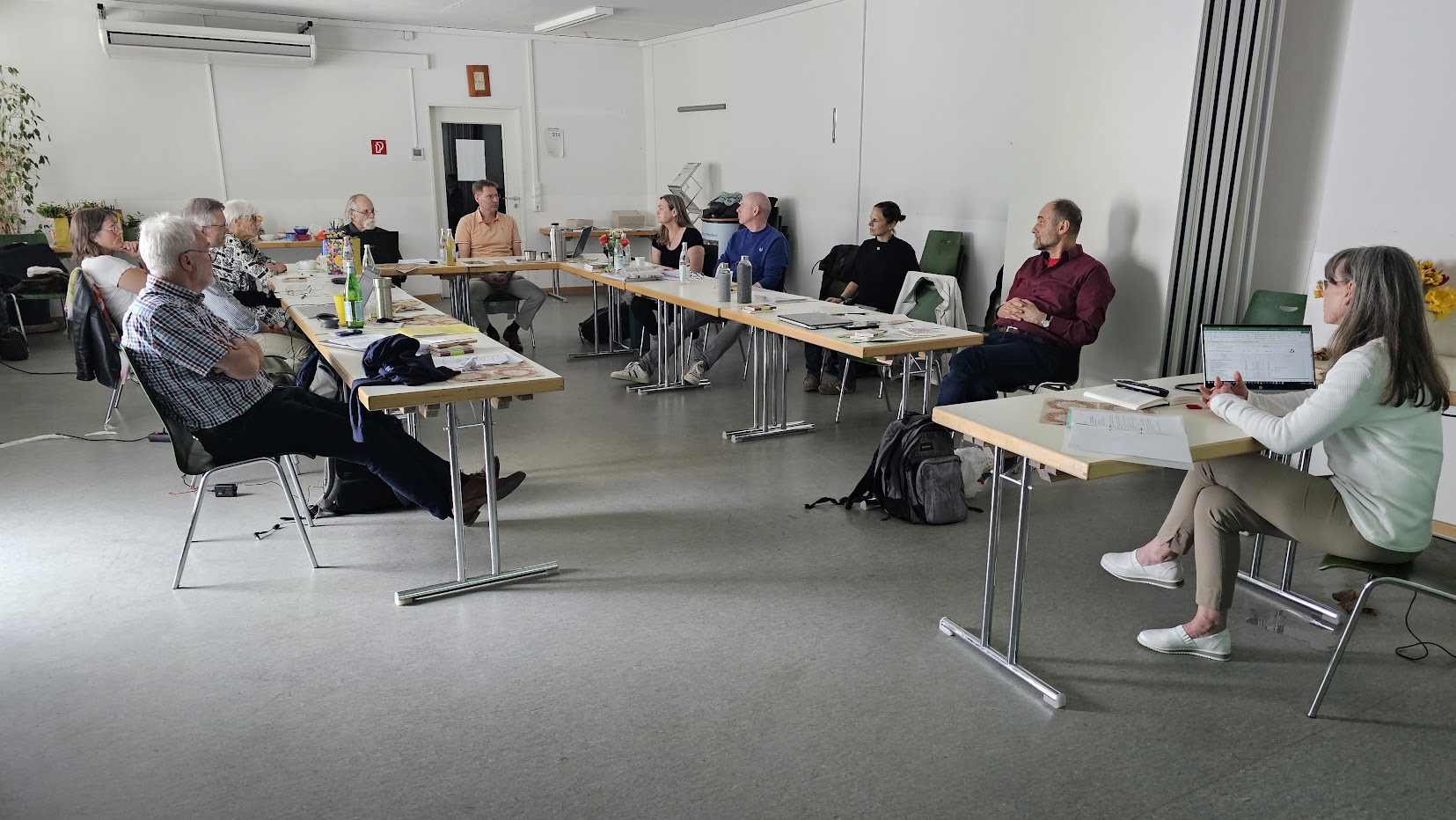
The annual members meeting of the association took place on April 13, 2024, at EineWeltHaus.
Dr. Thomas Mohr, chairman of the project group, led the meeting and, after his welcome, highlighted the main points of the event:
In addition, the executive board was newly elected:
Dr. Thomas Mohr remains chairman of the association. New to the executive board are
Matthias Linnemann and Katharina Rottmayr.
Mechthild Schreiber was elected honorary chairwoman.
Anja Ufermann has left the executive board but will remain with MSK verändern as an active member.
Gudrun Haas, long-time AK spokesperson for the project group, will retire from active association work at the end of the year.
We wish the new executive board every success in its work and thank Anja Ufermann and Gudrun Haas very much for their many years of passionate cooperation.
04/13/2024: MSK verändern Members Meeting Read More »