Matthias Linnemann

Announcement: 8th Munich Peace Meeting

At the suggestion and based on the concept of the project group “Changing the Munich Security Conference” (registered association), this non-public expert dialogue takes place annually with the participation of the Munich Security Conference (MSC) team . This year it will be held on October 21 (preliminary meeting on October 7).

Since 2019, this forum has provided a platform on which peace research, peacebuilding practice, and the peace movement can network with the MSC team, generating concrete input for the upcoming MSC in February of the following year. In connection with the paradigm of peace logic and based on the successful peace practice of the invited participants, we set topics and recommend guests/experts and formats for the MSC.

The objective for this year is formulated as follows: “Balancing the MSC: strengthening international diplomacy by anchoring it in the paradigm of comprehensive human security instead of excessive militarism.”

We have set ourselves the following guiding question: What needs to be addressed at the MSC, with whom, in what format, and with what substantive orientation, if it is to further develop as a platform for “comprehensive human security” (comprehensive human security)?

50 experts from 25 countries will deliberate in four independent focus groups:

  1. New world order: “Multilateralism in a new world order.” In view of shifting international alliances, the group will examine how insights from emerging and middle powers can shape definitions of security, with a focus on the influence of civil society in these countries on defining and shaping this human security.
  2. Nonviolence/Cultural resources: “The impulses and impacts of nonviolence and peace actions on human security.” How can insights from nonviolent collective action, as well as from traditional, religious, and spiritual leadership, be incorporated into international peace and security diplomacy?
  3. Women: “Women in leadership positions in the field of peace and security.” How can women’s voices be strengthened in the discourse on peace and security and be better heard? What would security and peace processes look like if no men were at the table?
  4. Next Gen: “The next generation for peace and security.” How can young people be empowered as agents of change for peace and security? How can the involvement of the next generation in international peace and security diplomacy be designed and ensured?

Announcement: 8th Munich Peace Meeting Read More »
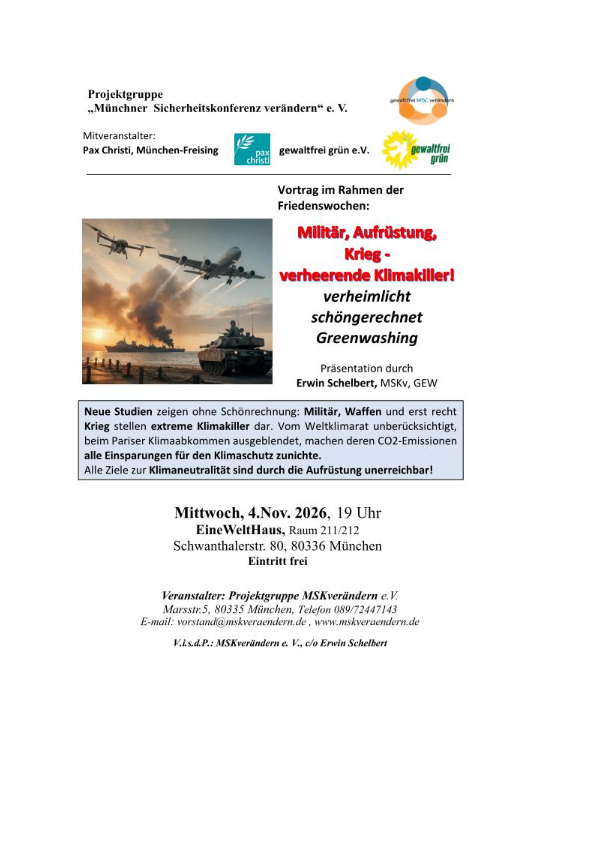
Announcement: Lecture as part of the Munich Peace Weeks

Where: EineWeltHaus, Room 211/212
When: Wednesday, November 4, 2026, 7:00 PM
Who: Erwin Schelbert, Project Group “Münchner Sicherheitskonferenz verändern” e.V.

Topic: Military, Rearmament, War – devastating climate killers!
Concealed – sugar-coated – greenwashing.

New studies show without sugar-coating: military, weapons, and especially war, represent extreme climate killers. Unconsidered by the IPCC and ignored in the Paris Climate Agreement, their CO2 emissions nullify all savings for climate protection.

All goals for climate neutrality are unattainable due to rearmament!

We look forward to your participation and an interesting discussion after the presentation.

Admission is free.

You can find the flyer for the event here

Announcement: Lecture as part of the Munich Peace Weeks Read More »

Thought Memo No. 48 – Peace or War? Human Ethics for Artificial Intelligence

Ladies and Gentlemen, dear friends of peace,

At the world-renowned Hannover Messe, German defense companies exhibited innovative production technologies “to support the security and defense industry.” Peace activists, scientists, and religious representatives have been warning for years about the danger of war posed by new automated weapon systems and Artificial Intelligence (AI). Instead of arms shows, we need a social dialogue that places AI within the framework of human ethics.

AI is in the process of changing the world: science, economy, geopolitics. The topic also plays a role at the Munich Security Conference (MSC), but with a one-sided focus on military and criminal use. The side event “From Cyberwar to Cyberpeace” proposed by MSKverändern, which addressed the ethical dimensions and peace-promoting potential of AI, was unfortunately not taken up by the conference management.

While AI is analyzed in the context of warfare and the digital competition between great powers, a link to insights from peace ethics, philosophy, and theology has been missing so far. There is also a lack of consideration for perspectives from the Global South. When one considers the global destructive potential of AI and its military and criminal use, this deficit is not just a blind spot, but a veritable security risk.

An intensive dialogue on ethical questions regarding AI would be important—between North, South, East, and West, and between politics, technology, ethics, and religious communities. In this regard, I was impressed by the Vatican’s sober and well-founded analysis: the role of human decisions in AI-supported warfare and the enormous AI resource consumption of energy and water are presented and weighed here (Antiqua et Nova, January 2025).

Experts compare the historical-transformative significance of AI to the invention of the atomic bomb. I call for spending not only vast sums on the military use of AI, but also investing in the peace-building potential of AI, e.g., in education, medicine, ecology, and development cooperation. For AI, too, the following must apply: less readiness for war, more capacity for peace!

And what are your thoughts on “Alexa, ChatGPT and Co.” at the MSC?

Sincerely,
Dr. Peter Bender

Peter Bender is a political scientist and theologian and a member of the board of Religions for Peace
Germany e.V. He regularly participates in the dialogue between MSKverändern and the
Munich Security Conference.

Thought Memo No. 48 – Peace or War? Human Ethics for Artificial Intelligence Read More »

MSKverändern Members’ Meeting 2026

On March 1, 2026, the annual members’ meeting of the association took place in the community center of the Erlöserkirche in Munich-Schwabing.
Dr. Thomas Mohr, Chairman of the project group, chaired the meeting and, following his welcome, outlined the key topics of the event:

  • organizational structure of the association
  • definition of thematic priorities
  • recruitment of new members and supporters
  • finances

In addition, the board was elected:
Dr. Thomas Mohr remains the Chairman of the association.
Katharina Rottmayr-Czerny and Matthias Linnemann were also confirmed in their positions.

The association wishes the board great success in their continued work!

MSKverändern Members’ Meeting 2026 Read More »

Observer Reports MSC 2026

This year, Dr. Inga Blum / IPPNW and Natalia Jagolski / Leiden University visited the Munich Security Conference for MSKv. Here are their interesting reports:

Observer Report Dr. Inga Blum

Observer Report Natalia Jagolski

In addition to intensive networking, the two MSC observers were able to use their conference visit to generate media attention:

Inga Blum contributed with a statement on nuclear weapons to the panel discussion “Under Reconstruction: A World Order for the Next Generation.”

Panel Discussion A World Order for the Next Generation
(the statement can be viewed from minute 25:00)

Inga Blum has also prepared a conference report for the organization “International Physicians for the Prevention of Nuclear War” (IPPNW):

Arms over norms: Military budgets given priority at security conference

Natalia Jagolski was approached by BBC News for an interview during the conference. For legal reasons, we are unfortunately unable to show this interview.

Thomas Mohr (Chairman MSKv) and Christoph Steinbrink (also MSKv) were interviewed by Radio Lora München. The focus was primarily on the question of whether the MSC and military strength actually contribute to greater security, and whether it is possible to exert influence on the conference. Inga Blum and Natalia Jagolski also have their say in this piece: What was discussed at the non-public MSC events? To what extent is a war scenario in 2029 being assumed? What role do diplomatic means play? And what about human security and the younger generation? The interview was conducted by Kevin Kaisig (Nord Süd Forum München e.V. – for a world of solidarity). Here is the link to the interview:

Eine-Welt-Report: The MSC 2026 – Dancing on a Volcano?

The daily newspaper “nd” reported extensively on the activities of MSKv in its article on the MSC 2026. Dr. Thomas Mohr and Dr. Inga Blum were quoted, and Natalia Jagolski was mentioned by name. Here is the link to the article:

Is the “Arms Bazaar” Reformable?

Note on the paywall: “nd” is among the financially struggling newspapers. If desired, the article can still be read free of charge. In addition to the standard subscriptions at “nd,” there is also the option to make a one-time payment.

Observer Reports MSC 2026 Read More »

Debriefing by MSKv’s MSC Conference Observers

As in previous years, MSKv sent two observers to the MSC.

This year’s conference observers, Dr Inga Blum and Natalia Jagolski, shared their impressions on February 15, 2026, as part of an event at the Hansa-Haus.

You can find information about our two conference observers here.

Here is the recording of the event, which was opened by Dr. Thomas Mohr (Chairman of MSKv) and moderated by Markus Brunnhuber (also of MSKv):


Debriefing by MSKv’s MSC Conference Observers Read More »

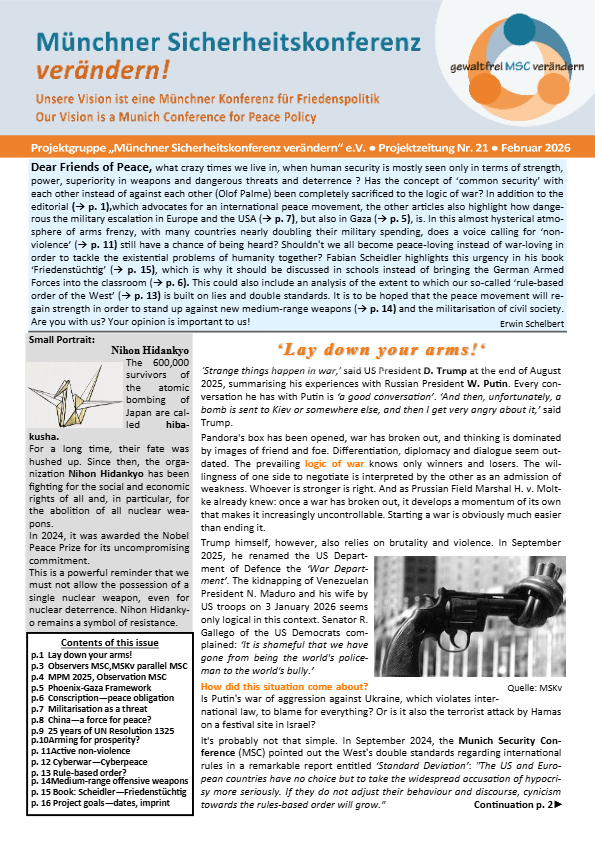
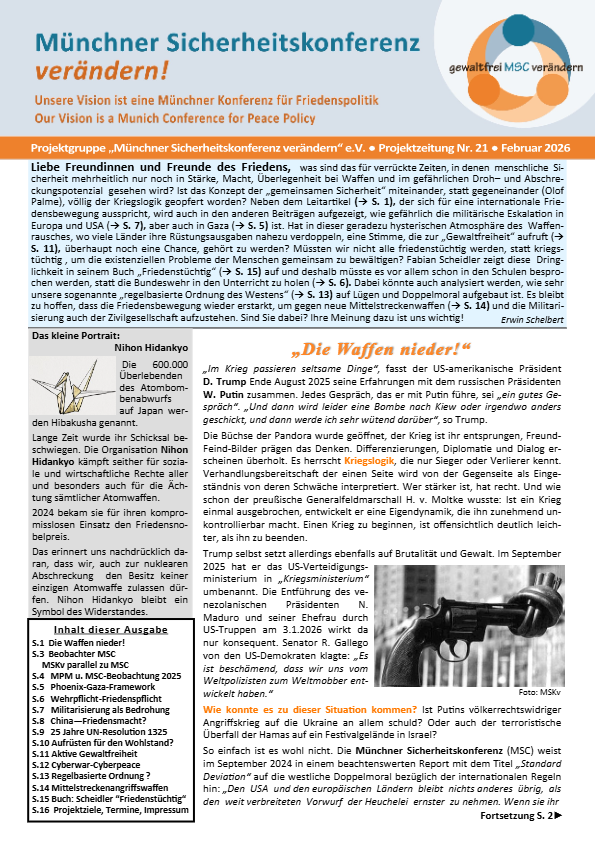
Project Journal Issue No. 21 for MSC 2026

Dear friends of peace,
the new issue of our project journal was completed on time for the Munich Security Conference. The past few months have been politically very turbulent. It was challenging to take the latest geopolitical developments into account. We are confident that we have once again succeeded in publishing an exciting and informative project journal. Here is a small preview:

“… what crazy times are these, in which human security is predominantly seen only in strength, power, superiority in weapons, and in dangerous threat and deterrence potential? Has the concept of “common security” with each other, instead of against each other (Olof Palme), been completely sacrificed to the logic of war? In addition to the editorial (→ p. 1), which advocates for an international peace movement, other contributions also highlight how dangerous military escalation is in Europe and the USA (→ p. 7), but also in Gaza (→ p. 5). In this almost hysterical atmosphere of arms frenzy, where many countries are almost doubling their defense spending, does a voice calling for “non-violence” (→ p. 11) still have a chance to be heard at all? Shouldn’t we all become peace-capable instead of war-capable, to jointly overcome humanity’s existential problems? Fabian Scheidler highlights this urgency in his book “Peace-Capable” (→ p. 15), and therefore it should primarily be discussed in schools, instead of bringing the Bundeswehr into the classroom (→ p. 6). This could also be used to analyze how much our so-called “rules-based order of the West” (→ p. 13) is built on lies and double standards. It remains to be hoped that the peace movement will regain strength to stand up against new intermediate-range missiles (→ p. 14) and the militarization of civil society. Are you with us? Your opinion on this is important to us!”

Don’t miss out on this issue!

Click here to go directly to the project newspaper:

… and here is the English version:

We look forward to your feedback on our new project journal.


Project Journal Issue No. 21 for MSC 2026 Read More »

Newsletter No. 25 on the Munich Security Conference 2026

Dear friends of peace,

The 62nd Munich Security Conference (MSC) will take place from February 13-15, 2026. Almost exactly one year ago, US Secretary of State Vance delivered a — to put it mildly — controversial speech at the Bayerischer Hof. It is now more than evident that the US administration intends to cling to the unipolar world order by all means. Relationships with long-standing “partners and friends” in Europe and the immediate vicinity (especially Canada) are being called into question. International law plays virtually no role anymore in the (often violent) enforcement of US interests. Threats and blackmail are being employed, regardless of whether the targets are NATO allies or Venezuela and Iran. While military action has already been taken in Caracas, and military intervention in Iran seems only a matter of time, the EU has once again gotten off with a “slap on the wrist.” However, US President Trump did not hesitate to threaten Denmark, and thus the EU, with the use of military force (“military force is always an option”) should an acceptable “deal” on Greenland not be concluded from the US perspective. This does not bode well for the next three years.

Russia continues its war against Ukraine, which violates international law. The attacks on energy infrastructure are taking a toll on Ukraine. The harsh winter is contributing to the deterioration of living conditions for many Ukrainians. Trump is eyeing the November midterm elections and aims to end the war by summer if possible. The current approach: increasing pressure on Ukraine to accept Moscow’s demands for territorial concessions. The issues of security guarantees for Ukraine, the establishment of demilitarized buffer zones, and the handling of the Zaporizhzhia nuclear power plant remain completely unresolved. Despite ongoing talks, a swift end to this war still does not appear imminent.

The war in Israel/Palestine has led to particularly high casualty figures and massive destruction on the Palestinian side. The US administration brokered a ceasefire a few months ago, which Israel, in particular, has been adhering to rather poorly. There are still almost daily deaths in Gaza. The USA has presented a kind of reconstruction plan for Gaza, in which the Palestinians, however, play virtually no role.

The EU remains largely invisible on the international diplomatic stage. This is primarily due to the role “assigned” to it by the USA. One can only hope that the EU — and thus Germany — will increasingly advocate for balance and conflict resolution in the future, and less for rearmament and militarization. However, EU Commission President von der Leyen recently once again brought up the idea of establishing an EU army. She is setting a course towards the “United States of Europe” to play a larger international role. This does not bode well for peace in Europe.

It is still unclear when Jens Stoltenberg will take over the leadership of the MSC. Therefore, Wolfgang Ischinger will temporarily fill this position again.

The MSC weekend will primarily revolve around the “rules-based international order,” multilateralism, and transatlantic relations. The MSC’s mission is “peace through dialogue.” Unfortunately, this mission is sometimes forgotten: while representatives of the Iranian government were disinvited, the son of the last Shah, Reza Pahlavi, who last set foot on Iranian soil in 1978, received an invitation. According to recent press reports, he will participate in the MSC 2026.

Matthias Linnemann, Co-Chair MSKv

Around the Munich Security Conference 2026

Information on events of the peace movement, the activities of our association at the MSC 2026 and our current project newspaper can be found under this link

Newsletter No. 25 on the Munich Security Conference 2026 Read More »

Around the Munich Security Conference 2026

During the MSC weekend in Munich you can – as in previous years – participate in many events of the peace movement:

For reading, there is again our current MSKv-project newspaper

We will also continue our activities to change the conference at the MSC 2026 on site:


Around the Munich Security Conference 2026 Read More »

Conference observation of our association at the MSC 2026

Dr. Inga Blum (Co-President IPPNW) and Natalia Jagolski (Junior Lecturer, Leiden University) will be our observers at the MSC this year.

New as observer: Dr. Inga Blum

As Co-President of the International Physicians for the Prevention of Nuclear War (IPPNW), I am very pleased to be an observer at the Munich Security Conference this year. My focus is on the growing risk of nuclear war, which is fueled by the current wars and conflicts and the armament of all nuclear weapon states.

How will the topic be discussed at the MSC? Are there any ideas for risk reduction and new arms control? How is the Treaty on the Prohibition of Nuclear Weapons assessed, which focuses on the humanitarian consequences of nuclear weapons and is already supported by over 70% of the international community?

I would like to discuss this with conference participants and specifically establish contacts with whom we can continue to work to strengthen humanitarian disarmament.

New as observer: Natalia Jagolski

As a Junior Lecturer in Security Studies at Leiden University and as an advocate for the Youth, Peace and Security Agenda (YPS), I experience that security is perceived as a topic that is too serious to involve young people. At the same time, expectations are growing that the young generation should take responsibility for national defense.

Both as a youth observer at the Peacekeeping Ministerial and Young Peacebuilder at the 2nd EU YPS Conference, the practical implementation of youth participation and meeting as equals remain a challenge. In times in which the rules-based international order is being questioned and the concept of security is increasingly defined militarily, it is therefore all the more important to promote generation-equitable approaches to peace and security.

I am therefore curious to see how this paradigm shift will be reflected at the MSC, and I hope that young people will be taken seriously as peace actors.

As MSKv, we are already very excited about the reports from our conference observers. Please make a note of the date and location: Review of the MSC 2026

Conference observation of our association at the MSC 2026 Read More »

Scroll to Top