Matthias Linnemann

Our Munich Peace Meeting 2025

The 7th Munich Peace Meeting (MPM), initiated and organized by MSKv, took place on September 29 and October 21, 2025. Participants from the fields of peace studies, the peace movement, and peace work exchanged views with Dr. Benedikt Franke and other representatives of the MSC on current security and peace policy challenges.

Concrete proposals for the 2026 Security Conference were jointly developed. We are very curious to see what activities the MSC will derive from this.

A short report on the Munich Peace Meeting 2025 can be found here: MPM 2025

Our Munich Peace Meeting 2025 Read More »

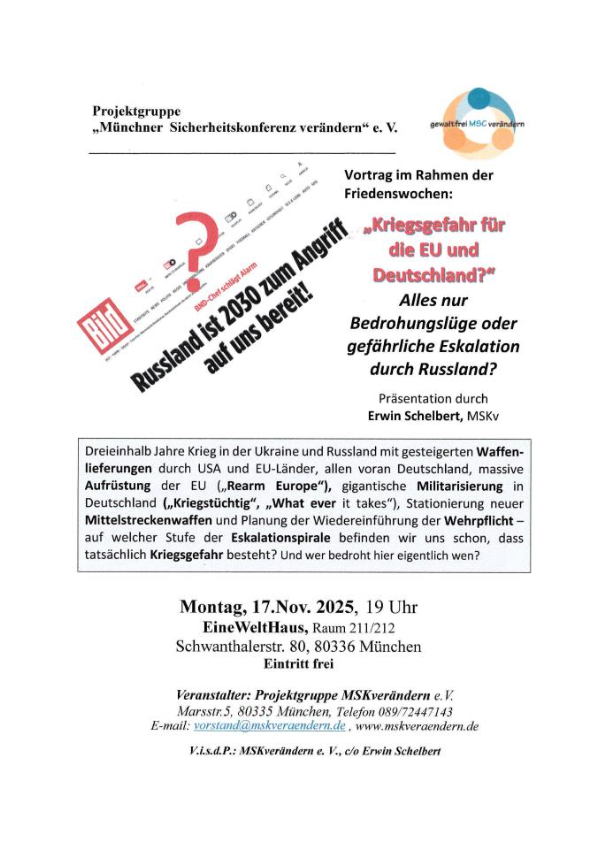
Announcement of lecture during the Peace Weeks: “Danger of war for the EU and Germany?”

Announcement: Lecture during the Munich Peace Weeks
Where: EineWeltHaus, Room 211/212
When: Monday, November 17, 2025, 7:00 PM
Who: Erwin Schelbert, Project Group “Changing the Munich Security Conference” e.V.

Topic: “Danger of war for the EU and Germany?”

All just a threat lie or dangerous escalation by Russia?

Are more armaments and new conscription therefore unavoidable?

Three and a half years of war in Ukraine and Russia with increased arms deliveries by the USA and EU countries, especially Germany, military maneuvers by NATO and Russia, drone landings in Poland and Lithuania, discussion about stationing troops in Ukraine from NATO countries up to threats of the use of nuclear weapons, massive armaments of the EU (“Rearm Europe”), gigantic militarization in Germany (“Fit for war”, “Whatever it takes”), stationing of new medium-range missiles and planning the reintroduction of conscription – on which level of the conflict escalation spiral (Friedrich Glasl) are we already, that there is actually a danger of war and therefore shelters must be built and food supplies should be created (“Prepper”, Green Book)? And who is actually threatening whom here? Is there still a chance to reach a peace order in Europe and what would have to be undertaken by the Nobel Peace Prize winner EU (2012) and by Germany?

These and further questions will be clarified and discussed on the basis of the realistic facts, whereby it is also demanded that the Munich Security Conference, if it is really about peace in the world, provides a discussion forum for this, on which different voices from East and West can also be heard.

You can find the flyer for the event here

Announcement of lecture during the Peace Weeks: “Danger of war for the EU and Germany?” Read More »

09/19/25: Denkmail No. 47 – Nonviolent defense is effective

Dear friends of peace,

The federal government immediately forged a “license for debt” for its start. Conscription, arms expenditure of up to 5% (!) of the money earned by the people in the country, and range threats of weapons determine the discussion. And it is true: The fear of further escalation is real – and understandable. And the narrative of rearmament as the only logical answer is easily grasped. And yet many feel: This doesn’t really feel good.

Peace Congress shows: Nonviolent defense is effective – and inspires people

Over Easter this year, the online congress “Peace is Possible” with over 6000 participants took place in Germany. The intention was to reach people beyond the classic peace movement and to show: Nonviolent alternatives to military rearmament exist, they are tried and tested and effective.

And indeed, this was successful. The events met with enormous interest and resulted in lively resonance, courage and a spirit of optimism. For many, it became clear for the first time or again: Security can also be created through civilian, nonviolent strategies – and it works. This was shown, among others, by Betty Bigombe, Ugandan Minister, and the nonviolent Israeli-Palestinian campaign Combatants for Peace.

What made this congress so powerful was the wide range it spanned – from international politics to concrete peace work to the awareness of a personal inner peace. Political discussions and international diplomacy often remain abstract. The desire for viable alternatives to military logic is great. When people experience themselves as capable of acting, it shows that there is not only the choice between powerless passivity or military action. Feel free to read more at https://friedenistmoeglich.de/

The social openness for this perspective is there – it is waiting to be politically taken up. At the international Munich Peace Meeting of MSKv this October, this will be taken up from the perspective and expertise of 50 peace activists from 21 countries and discussed with the Munich Security Conference. Peace is not a state – it is a decision. Join us?

Sincerely,
Gerhard Rothaupt
Guest author MSKv

09/19/25: Denkmail No. 47 – Nonviolent defense is effective Read More »

Announcement: 7th Munich Peace Meeting 2025

On the initiative of the project group ‘Münchner Sicherheitskonferenz verändern’ e.V. and with the participation of the Munich Security Conference team, a Munich Peace Meeting has been held annually since 2019 as a non-public expert discussion.

The Munich Peace Meeting (MPM) has developed into an important event where
– peace research, peace work, the peace movement, and the MSC network,
– an in-depth expert exchange on aspects of security and peace policy takes place,
– concrete suggestions for the upcoming MSC in February each year can emerge regarding topics, guests, and formats.

The 7th Munich Peace Meeting will take place on September 29, 2025 (Part 1) and October 21, 2025 (Part 2).

The following key topics are planned:

  • Role of women in sustainable conflict transformation and peacekeeping
  • Influence of culture, religion, and tradition on security and peace instruments
  • Contribution of active non-violence and civil peace work to peacekeeping and stability
  • Social justice and inclusion as central foundations of constructive and sustainable peacebuilding

We will inform you about the results and further activities after the conclusion of the MPM 2025.

Announcement: 7th Munich Peace Meeting 2025 Read More »

July 7, 2025: MSKverändern General Meeting

On July 6, 2025, the association’s annual general meeting took place at the “Leiden Christi” Parish in Munich-Obermenzing.
Dr. Thomas Mohr, Chairman of the project group, chaired the meeting and, following his welcome, outlined the key topics of the event:

  • organizational structure of the association
  • definition of thematic priorities
  • recruitment of new members and supporters
  • finances

In addition, the board was elected:
Dr. Thomas Mohr remains the Chairman of the association.
Katharina Rottmayr-Czerny and Matthias Linnemann were also confirmed in their positions.

Two new association members were welcomed. The event was also used to commemorate the valuable work of the honorary chairwoman Mechthild Schreiber, who passed away last year.

The association wishes the board every success in its work.

July 7, 2025: MSKverändern General Meeting Read More »

06/07/25: Denkmail No. 46 on the stationing of medium-range missiles in Germany (Berlin Appeal)

New US medium-range missiles in Germany?

Dear friends of peace,

A year ago, the then Chancellor Scholz tersely announced that the German and US governments had bilaterally agreed that the Americans would station new medium-range missiles in Germany from 2026 onwards.

These are offensive weapons of the types Standard Missiles (SM-6), cruise missiles (Tomahawk) and hypersonic weapons (Dark Eagle, 17 times the speed of sound), ranges of 1700 km up to 2800 km, conventional warheads, but in principle also nuclear-capable, under the sole command of the USA. Planning for this began in 2017, long before the Ukraine war.

In 2019, the USA announced its withdrawal from the existing INF Treaty, citing an alleged capability gap. The planned stationing is not linked to any disarmament offer.

Due to the capabilities of these weapons (extremely short warning times) and the proximity to Russia, this step represents a dangerous escalation of the arms spiral and an enormous threat, especially to Russia. In a joint declaration by Presidents Putin (Russia) and Xi (China) on 4 February 2022, the danger of a “decapitation strike” emanating from this is therefore mentioned. This also means an incalculable threat for Germany. Dr. Erich Vad, Brigadier General (ret.), therefore says: “The stationing agreement is not acceptable from a German and European point of view.”

Since this gigantic build-up has not even been discussed in the Bundestag or a resolution passed, a majority in Germany rejects the stationing (Forsa survey) and the corresponding Berlin Appeal has so far been signed by 60,000 people, a broad public discussion must be held on this threatening measure with all its implications.

If the Munich Security Conference (MSC) really wants to be an open forum for all security issues, it is essential that it be discussed there in a broad framework with proven experts from science, politics, peace work, citizens’ councils and also experienced military personnel (Erich Vad, Harald Kujat, Wolfgang Richter)! And please do not only invite those seasoned talk show participants who argue with war logic and are well-known from the media, such as Carlo Masala, Klaus Mölling, Claudia Major or Nicole Deitelhoff!

What do you think about this? We look forward to hearing your views!

With peaceful greetings
Erwin Schelbert


06/07/25: Denkmail No. 46 on the stationing of medium-range missiles in Germany (Berlin Appeal) Read More »

Newsletter No. 23 on the Munich Security Conference 2025

Dear friends of peace,

From February 14-16, 2025, the 61st Munich Security Conference (MSC) will take place at the Bayerischer Hof. This year, the event will undoubtedly be shaped by how the Trump administration aligns U.S. foreign policy and what impact this will have on NATO and the war in Ukraine. Although the new Secretary of State, Marco Rubio, spoke in an interview about the benefits of a multipolar world, this does not necessarily mean the end of U.S. hegemony. The brutal approach President Trump pursues has already become evident with regard to tariff policies towards Canada, Mexico, and China, and the handling of Panama and Greenland.

The war in Ukraine has been raging for almost exactly three years. The loss of life and destruction of infrastructure in Ukraine, as well as the death and injury of soldiers on both sides, remain immense. Whether the US will hold substantive talks with Russia is still unclear. So far, there have only been lip service from the American president. There can currently only be speculation about talks already taking place behind the scenes.

The war in Israel/Palestine has led to particularly high casualties and disastrous destruction on the Palestinian side. There is currently a ceasefire in place, which is being used to exchange hostages and prisoners. How this very bloody conflict will develop further is currently unclear.

The entire EU has been more noticeable in the war in Ukraine and the war in Israel/Palestine through escalation and arms deliveries than through diplomacy and de-escalation. EU states have also played virtually no mediating – and certainly no moderating – role in the regime change in Syria, which was primarily prepared by the USA over many years: arms deliveries and sanctions have seemed to be the means of choice in the EU for several years. Diplomatic initiatives are barely discernible. Individual pioneers are quickly curbed (Spain, Hungary).

It remains to be hoped that the EU – and thus also Germany – will be more committed to compromise and conflict resolution in the future. However, in view of the latest statements by EU Commission President von der Leyen, there are major doubts: she is calling for even more money for armaments and even more militarization of society.

Christoph Heusgen is to hand over the conference management to the former Norwegian Prime Minister and long-time NATO Secretary General Jens Stoltenberg at the end of the MSC 2025. However, as he will now take over the office of Norwegian Finance Minister, it remains unclear when and how Stoltenberg will influence the design of the MSC.

With regard to the war in Ukraine, Jens Stoltenberg has often not been noticed for de-escalating contributions. In October 2024, however, Stoltenberg explicitly spoke out in favor of negotiations and brought a “Finlandization”, i.e. a largely neutral status for Ukraine, into the discussion (Der Freitag, 18.10.2024).

How will Jens Stoltenberg position himself as the new head of the Munich Security Conference? What influence will he have on the orientation of the MSC in times of existing global and additionally developing regional wars and conflicts? What is Stoltenberg’s concept of “security”?

Our MSKv project group celebrated its 20th anniversary in 2024. Since 2004, we have been working to ensure that the security logic at the MSC is replaced by a peace logic. Where were we able to set accents, where were we able to stimulate reflection? What has the work of our small team achieved at all? More about this in our new MSKv newspaper.

Matthias Linnemann, Member of the Board MSKv

Around the Munich Security Conference 2025

Information on events of the peace movement, our association’s activities at the MSC 2025, and our current project newspaper can be found via this link


Newsletter No. 23 on the Munich Security Conference 2025 Read More »

Scroll to Top